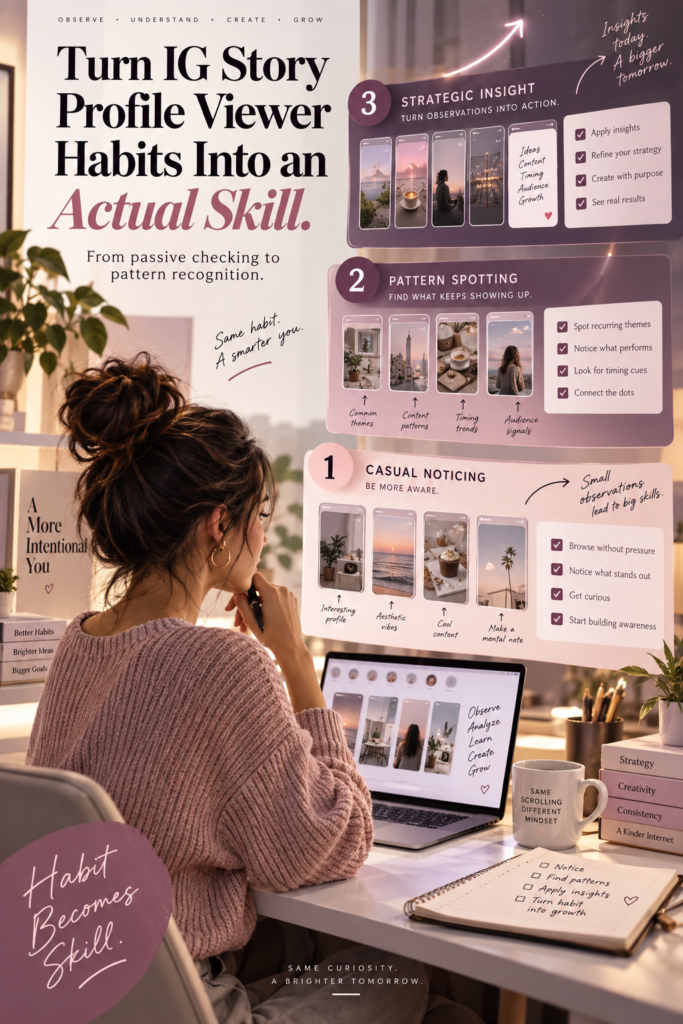
Let’s be honest about something first: most creators check competitor Stories the same way they check their own notifications, out of habit, half paying attention, learning almost nothing from it. That’s not a knock on anyone, it’s just what happens when nobody ever frames this as a skill worth building on purpose. Research through an IG story profile viewer can genuinely sharpen how you spot trends and understand what’s landing with an audience, but only if you treat it like a skill instead of a tic. Here’s what that actually looks like, broken into three levels, each one assuming you’ve genuinely absorbed the one before it.
Beginner: Just Get the Basics Down
Nobody starts here fluent, and that’s fine. The whole point of this level is building comfort, not mastery.
Skill 1: Know what you’re hunting for before you open anything. Are you checking a competitor’s posting frequency? Trying to understand how someone structures a Story sequence? If you can’t name the question, you’re going to end up with a mushy, forgettable impression instead of anything useful. That’s the single biggest thing separating a good IG story profile viewer session from a wasted five minutes, and it’s the easiest habit on this whole list to fix once you actually notice you’re skipping it.
Skill 2: Learn to spot a decent tool from a garbage one, fast. The good ones want a username and nothing else. The bad ones bury your result under ads or nudge you toward some sign-up you didn’t ask for. Once you’ve been burned by a bad one a couple of times, spotting the difference becomes almost automatic, and honestly, that instinct transfers to evaluating basically any tool you’ll use repeatedly.
Skill 3: Learn to tell curiosity apart from research. Sometimes you’re just scrolling, and that’s completely fine. But beginners tend to treat every idle glance like it’s data, which just clutters up your head with noise instead of anything you can act on.
Check yourself: Could you explain, in one sentence, why you looked at a specific Story today? If the honest answer is “I don’t know, I was just looking,” you’re still in browsing mode. Nothing wrong with that, just know which one you’re doing.
Intermediate: Make the Observations Mean Something
Once the basics stop feeling clunky, the real shift happens here, from just checking Stories to actually pulling something useful out of them.
Skill 4: Watch for patterns across accounts, not just one. One creator doing something interesting tells you about that one creator. The same thing showing up across five accounts in your niche? That’s a trend, and trends are worth your attention in a way individual quirks aren’t. This is where a lot of intermediate creators start actually using an IG story profile viewer with intention instead of just poking around.
Skill 5: Pay attention to sequencing, not just single Stories. How someone orders a multi-part sequence, teaser, payoff, call to action, tells you far more about their strategy than any single slide ever could on its own. This is honestly where a proper IG story profile viewer starts earning its keep, since reviewing a full sequence back to back reveals structure you’d absolutely miss scrolling through it live, half-distracted by your own feed.
Skill 6: Stop researching randomly and start timing it. Checking competitors whenever the mood strikes gives you scattered anecdotes. Checking around predictable moments, launches, seasonal pushes, platform updates, gives you something closer to an actual trend line worth acting on. Random checking feels productive in the moment but rarely adds up to anything you could actually explain to someone else afterward.
Check yourself: Pick three accounts in your niche right now. Can you name one structural choice each of them makes that you genuinely hadn’t noticed before? If yes, the skill’s developing exactly the way it should.
Advanced: Make It a Habit That Doesn’t Eat Your Life
This last level isn’t really a new skill on its own, it’s about turning everything above into something you just do, consistently, without it quietly becoming a black hole for your time.
Skill 7: Keep a lightweight log. Advanced creators don’t just look, they jot things down. A handful of bullet points per account per week is plenty. Your memory won’t hold onto enough detail across dozens of accounts over months, so a light tracking habit does the remembering for you.
Skill 8: Know when to stop looking and start making something. This is the trap almost everyone falls into eventually. Research feels productive right up until it’s just procrastination wearing a strategy costume. Pick a limit, a set number of accounts, a fixed time block, before you even open your IG story profile viewer for the day, and stick to it. If you catch yourself justifying “just one more account” for the fifth time in a session, that’s the tell.
Skill 9: Try teaching it to someone else. If you mentor other creators or run a small team, explaining your process out loud is one of the fastest ways to expose the weak spots in your own habit. Can’t explain why you check what you check? That’s usually a sign the habit needs tightening before it’s worth handing off.
Check yourself: Could someone else pick up your current process and run it without you needing to clarify anything? If not, the whole thing is still living in your head, which makes it fragile the moment you’re too busy to do it yourself.
Where This Actually Pays Off
None of this is about becoming some kind of expert in a browser tool. It’s about giving a genuinely useful research habit the same care you’d give any other creative skill, writing hooks, editing footage, keeping up with an algorithm change. The accounts and patterns worth studying are already sitting there in plain view through an IG story profile viewer, no special access needed, nothing sneaky about it. The only real question is whether you turn that visibility into something structured and repeatable, or let it stay a passive scroll that happens to include a few competitors mixed in.
Most people never get past beginner, honestly, and it’s not because the skill is hard. It’s because nobody ever frames it as a skill in the first place. It just gets treated as background noise, something that happens near your real work instead of something that supports it. A blogger who’s put even a modest amount of deliberate effort into this tends to notice patterns weeks before someone still browsing on autopilot ever catches up.
Your Next Move
If you’re still sitting at beginner, don’t go read another article about this, go do the exercise. Pick three accounts right now and run through the check-yourself questions above before moving on to anything else. Skills like this build through repetition, not through absorbing more theory about what the skill is eventually supposed to feel like.
Open an IG story profile viewer, pick your three accounts, and see what actually shows up before you read anything else on the topic. Give it fifteen minutes, no more, and resist the urge to turn it into a bigger project than it needs to be on day one. The goal right now isn’t a polished research process, it’s just proof to yourself that you can ask a specific question and come away with a specific answer. Everything else on this list builds from that one small habit, so it’s worth getting right before chasing anything more advanced.